

Last week, Interbrand released its popular Best Global Brands 2026 industry report. The report ranks the top 100 most valuable brands worldwide and examines the factors that contribute to their growth.
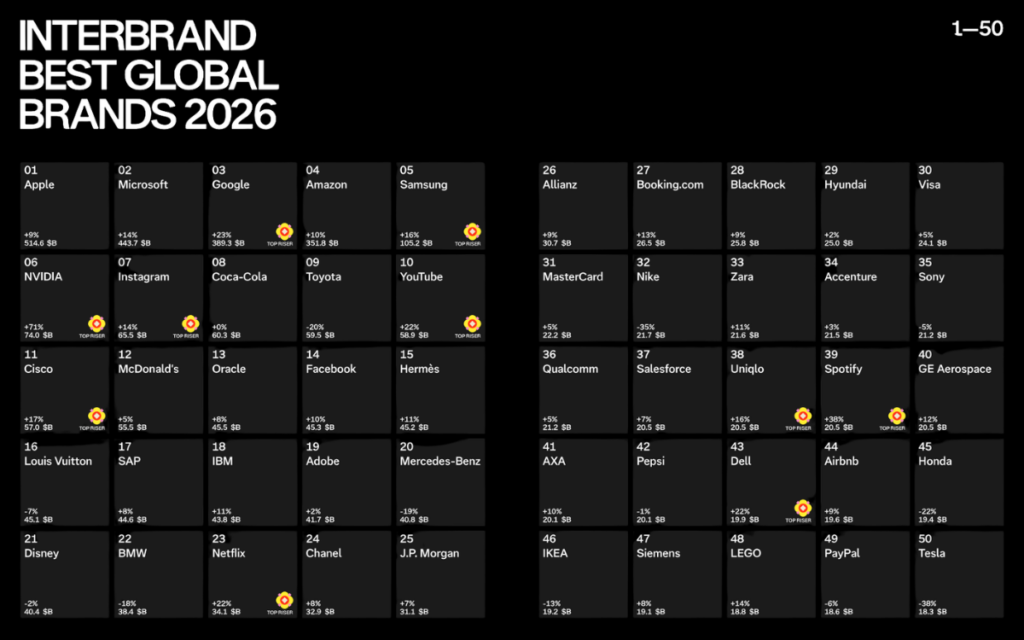
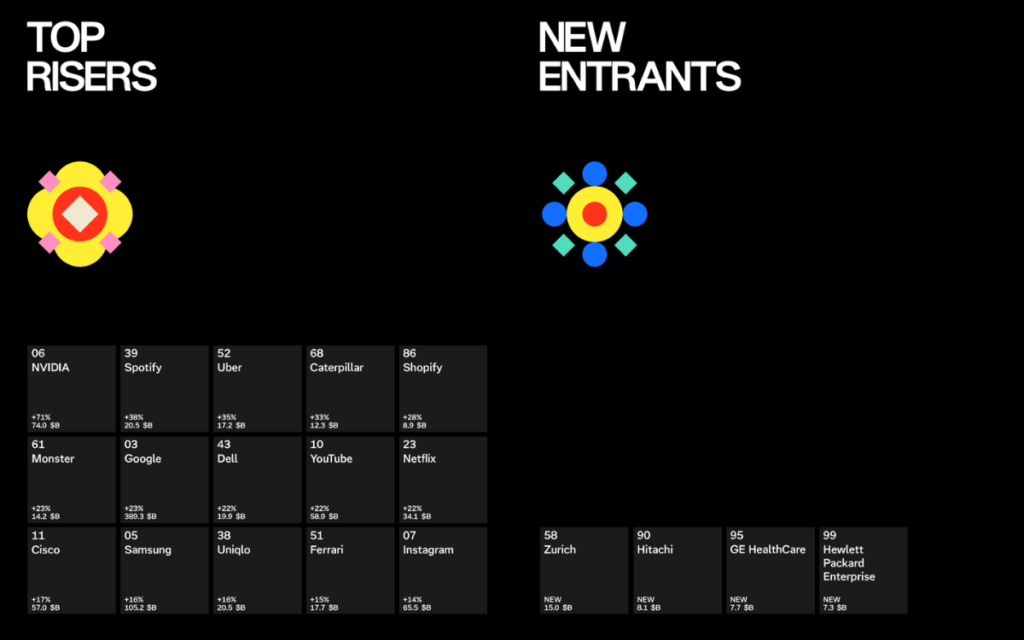
This year, the combined value of the 100 brands reached a record $3.9 trillion, representing an 8.1% increase from $3.6 trillion in 2025. In total, 68 brands increased in value. The technology sector continues to dominate the ranking: nine tech brands represent 48% of the total value. NVIDIA stands out with a 71% increase, making it the fastest-growing brand in the ranking.
Beyond the numbers, the report highlights a key shift in the branding field: while artificial intelligence makes technological capabilities more accessible than ever, companies need to find new ways to differentiate themselves.
In this article, we will summarize:
- The companies that made it into the top 25
- The 5 key insights from this industry report
Please note that this article is independent of Interbrand. Our intention is to share valuable insights that could benefit branding professionals.
Proven Systems for Business Owners, Marketers, and Agencies
→ Our mini-course helps you audit and refine an existing brand in 15 days, just 15 minutes a day.
→ The Ultimate Brand Building System is your step-by-step blueprint to building and scaling powerful brands from scratch.
Table of Contents
Which Brands Made It to the Top 25 List?
According to this year’s report, the top 25 most valuable brands in 2026 include Apple, Microsoft, and Google, which occupy the top three positions. Next in the top 10 come Amazon, Samsung, NVIDIA, Instagram, Coca-Cola, Toyota, and YouTube.
The rest of the top 25 includes Cisco, McDonald’s, Oracle, Facebook, Hermès, Louis Vuitton, SAP, IBM, Adobe, Mercedes-Benz, Disney, BMW, Netflix, Chanel, and JPMorgan.
The ranking is largely dominated by technology brands, alongside luxury, consumer, and entertainment brands.
The report also categorizes brands to watch, fast risers, and new entrants. The complete top 100 ranking is available in the report.
Insight #1: In the AI era, human wisdom is a differentiating factor
AI gives companies access to new abilities and capabilities, and these capabilities are getting more advanced every day. And while AI can resolve highly complex problems and optimize decisions, it cannot define on its own which problems should be solved first.
Interbrand makes a distinction between intelligence, which allows us to know what can be done, and wisdom, which allows us to decide what should be done.
Because machines can make more and more decisions, the role of leaders is changing too. Their role isn’t solely to make decisions anymore. Leaders today should define the principles that will guide those decisions. In a world where AI is becoming highly accessible, human wisdom is becoming a key differentiator.

Insight #2: Brand philosophy is becoming a competitive advantage
For a long time, companies have built their competitive advantage around capabilities and technological skills. But with the arrival of AI, these are easier to replicate. According to Interbrand, a brand’s and company’s philosophy is what can make a difference.
By philosophy, the report means what the organization stands for, the values it represents, and the principles that guide its choices. The brand becomes the place where this philosophy is preserved and expressed across 4 dimensions:
- The identifiers through which it is recognized: the visual, verbal, and sonic elements through which people can recognize the brand.
- The structures through which it delivers and earns trust: the systems, procedures, and governance that allow the brand to keep its promises.
- The experiences through which it treats its customers: the way a brand interacts with and treats its customers.
- The ecosystem through which it enables them to do more: the partners and technologies that can extend the brand’s actions.
Apple is a good example that illustrates this approach. Over 50 years, the company has invested in many sectors while maintaining a recognizable philosophy. Its activities evolve, but the fundamental principles remain the same.
Insight #3: The brand must move to the core of the organization and become its constitution
Interbrand emphasizes the fact that branding can no longer be considered only a part of marketing. Branding must be a central part of the organization’s overall strategy and become its constitution: a set of principles that guide the decisions, behavior, and overall activities of the organization.
This approach requires an aligned internal culture and governance capable of ensuring that everyone respects those principles. To reach this goal, Interbrand recommends using a 5-step methodology: diagnosis, philosophy, culture, four dimensions, and proof. Brand leaders should answer these eight questions:
- Diagnose: Which principles do we actually live by, and where do our decisions contradict them?
- Write the Constitution: Which principles will we keep, whatever they cost?
- Align the Culture: Does everyone live by the same principles, and who decides when machines do?
- Define the Identifiers: What makes us unmistakable, wherever we appear?
- Set the Structures: What is our one promise, and what must we build to keep it?
- Design the Experiences: What should it feel like to be our customer?
- Build the Ecosystem: What do we let customers do, and which partners and technologies do we trust to make it possible?
- Prove It: How will employees, customers, and investors know it’s working?
Insight #4: The brands that stand out reorganize their actions around their philosophy
If having a clear and strong brand philosophy is so valuable, why is it that companies can’t seem to put it into practice? Interbrand identifies two obstacles.
The first is the historical tendency to consider capabilities difficult to acquire and philosophy something that isn’t necessarily a priority. The arrival of AI, however, is changing this tendency: capabilities are becoming widely available, and the most difficult questions are now the philosophical ones. What do we stand for? And what are we ready to say no to?
The second challenge is execution. Building a brand is one thing, but organizing the entire organization around its principles requires a long-term, strong commitment from leadership, organizational culture, and governance. A brand whose principles are reflected in its daily actions, experiences, and relationships becomes a system that makes sense to its customers. It makes them trust the brand more. This consistency is difficult to implement, but also hard to copy.

Insight #5: The value of the brand translates into measurable financial results
Lastly, people working in branding know how difficult it can be to prove its value and its correlation with future financial results. Interbrand analyzed its Best Global Brands database over the years and confirms that branding has concrete financial benefits:
- A brand whose philosophy is clearly understood by external audiences can reduce its price-to-earnings volatility range by up to 26%.
- Distinctive brand identifiers enhance marketing efficiency and accelerate market cycles, making it possible to redirect up to 13% of redundant spending.
- Well-defined organizational structures strengthen consistency across the business and can reduce human resource costs by up to 12%.
- Translating these principles into consistent and cohesive brand experiences can boost return on ad spend (ROAS) by up to 33% while decreasing operating capital needs by up to 15%.
- A strong and interconnected internal ecosystem can drive sales growth up to 40% higher than that of competitors.
And according to the report, a “1% rise in Interbrand calculated brand value leads to share price increase the following year”.
Conclusion
One of the key highlights of the report is the need for organizations to reconsider the way they see branding.
Branding professionals have long understood how branding shapes business decisions, but as AI makes technology more accessible, putting branding at the core of business strategy is more important than ever.
This shift requires much more than a distinctive identity or clear messaging. Strong brands today need strong leaders who use the brand’s principles as a compass, commitment from the entire organization, and coherent internal alignment across all touchpoints with customers and stakeholders.
For branding professionals, the report serves as a reminder of the importance of building brands that not only communicate what the organization stands for, but also guide all its decisions and actions in a practical way.
We can conclude with this quote from the report: “In a sea of intelligence, wisdom is the helm – and brand is where it lives”.
Curious about the previous reports? Read our summaries of the 2025 and 2024 editions here:
Five Key Insights From Interbrand’s Best Global Brands 2025 Report
Five Key Insights From Interbrand’s Best Global Brands 2024 Report