


Brand authenticity is an increasingly unattainable Holy Grail. Authenticity is important. Brands build emotional trust when their audience perceives that a brand’s voice reflects the brand’s identity.
When a brand creates an ad or publishes a social media post that feels inauthentic, the audience feels like they are being lied to emotionally. But it seems like we have lost the plot in our quest for authenticity.
Proven Systems for Business Owners, Marketers, and Agencies
→ Our mini-course helps you audit and refine an existing brand in 15 days, just 15 minutes a day.
→ The Ultimate Brand Building System is your step-by-step blueprint to building and scaling powerful brands from scratch.
Table of Contents
A War Is Raging, and Brands Are Caught in the Crossfire
There is a war going on in the marketing industry over how AI is used to help a brand express its voice. Consumers say they don’t want brands to use AI in their content even as people adopt AI on social media sites like LinkedIn. Legislators have entered the chat, with the EU AI Act and U.S. statutory law compelling brands to disclose their use of AI, which actually muddies the waters of authenticity more than it does clarify anything.
Nothing is off limits: images, words, video, social media copy, you name it, it’s being scrutinized for “authenticity.” Meanwhile, AI is getting better at imitating humans. People who create content are being accused of using AI even if they didn’t use AI. What does brand authenticity even look like as the lines between human expression and AI are blurring?
The Nike Brouhaha
Earlier this year, Nike ran an ad that featured Italian tennis star Jannik Sinner. Everything about the ad worked. Nike used a compelling photo of Sinner in Nike-branded clothing with his racket extended over his head during a match. The image screamed intensity, and the tagline, “Actually, you can win them all,” was a sly clapback to the popular wisdom “You can’t win ‘em all” in light of his stunning run of victories.
But when Nike posted the photo on social media with the caption, “This isn’t just history — it’s his story in the making,” the ad suddenly became about the caption, not the ad itself, with some users complaining that the caption was AI-generated.
I have no idea whether Nike used AI to write one sentence in a social media post. No one does. In the case of the Nike ad, users flagged the copy because it used a familiar ChatGPT “it isn’t y, it’s z” sentence construction along with the em dash, a punctuation mark commonly used with AI.
But it doesn’t matter. The ad was tried in the court of public opinion and condemned as AI generated. The thing is, AI is getting better at imitating how humans create content to the point that our work is being judged by whether it used AI and to what degree, not whether it’s any good. The outcry from the AI police online is getting louder and louder, too. How do we really know if AI was used, and to what degree? Is it now illegal to use an em dash in a byline or an ad — like I just did here? We are now at a point where brands are beginning to lose sight of their identities as they get distracted by a tiresome game of trying to not sound like AI instead of trying to sound like themselves.
To wit: how authentic is your voice if you’re now factoring in “I don’t want to sound like AI” in the content you create? That kind of mentality, which has taken hold among brands, is a sign that AI is influencing your voice whether you realize it or not.

The AI Solution
Supposedly AI has a solution to the problem that AI created, but it’s an imperfect one, and I’m not sure it’s going to work.
Since August 2, Anthropic’s Claude models have been generating text that contains a watermark that determines, in Anthropic’s words, “the likelihood that Claude was involved in writing the text.” Anthropic instituted the watermark to comply with the EU AI Act. It’s part of a code of conduct that 190 organizations signed, so I suppose this means more watermarks are coming from other businesses.
The announcement about the watermark inspired cries of triumph from the AI police. Finally, here was a way to call out anyone, including brands, using AI. But watermarking does not provide a clear outcome. For one thing, it does not act like some kind of AI detector that anyone can use. You need a special key to analyze the text, and an organization needs to apply to get it. Anthropic says that its use is restricted to organizations as required by EU law, like media and educational institutions.
And the watermark is simply proof that Claude was involved somewhere in the creation of the content. The watermark will appear on content that you asked Claude to proofread. It will appear on content that you asked to edit. It’s also anonymous, meaning that it won’t say who exactly used Claude. A piece of copy that is reviewed multiple times by an agency and its client could receive the watermark (aka the AI Scarlett Letter) if only one person in the review chain decided to use Claude to improve a headline that didn’t quite align with the brand’s voice.
For more definitive proof of AI’s involvement, organizations and individuals are resorting to AI detectors, and the proliferation of tools feeds into a distracting conversation about “Did they or did they not use AI?” instead of “Does this content move me? Does it feel like the voice of the brand?” Some of these tools are supposedly better than others at telling you how much copy was likely generated by AI, but here again, AI sentence patterns and words are getting better by the day, and as a result, human-generated content is being flagged as AI.
And what, exactly, is the arbiter for authenticity with AI detector tools? Is brand copy authentic only if 100% of it passed the test of AI detection? Eighty five percent? Sixty percent?

Big Tech Imposes AI
And here is the irony: while we fret over the use of AI in the content creation part, AI continues to work its way into the entire ad generation and launch process. Tools like Google’s AI Max and Amazon Ads Agent take your content and figure out where to place it to what audience, including functions like bidding and keyword choices. Meta’s Advantage+ and Google’s Performance Max can use AI to tweak a headline and an image to suit an audience, and a brand might not even be aware of decisions that AI is making on their behalf, to the detriment of at least one high-profile brand. It’s all happening in a black box.
We might be asking the wrong question after all. While the conversation in marketing focuses on “How much of this ad was created by the brand’s people?” the decisions that have the most influence over a brand’s relationship with its audience are happening elsewhere in the content distribution.
What to Do
I don’t think the solution is for brands to adopt a “No AI used here!” pledge as some have. Those types of claims put a brand at an even greater risk for being called out as inauthentic if and when some aspect of their work turns out to have been touched by AI.
Brands, instead, should actively participate in the conversation about how AI is being used. This could take the form of a “How we use AI in marketing” on the brand’s website, sharing more context and clarity about the ever-evolving nature of AI and why a brand might use it to work more efficiently and actually improve content, such as A/B testing images and headlines. Meanwhile, all brands need to hold technology firms more accountable for how they are applying AI.
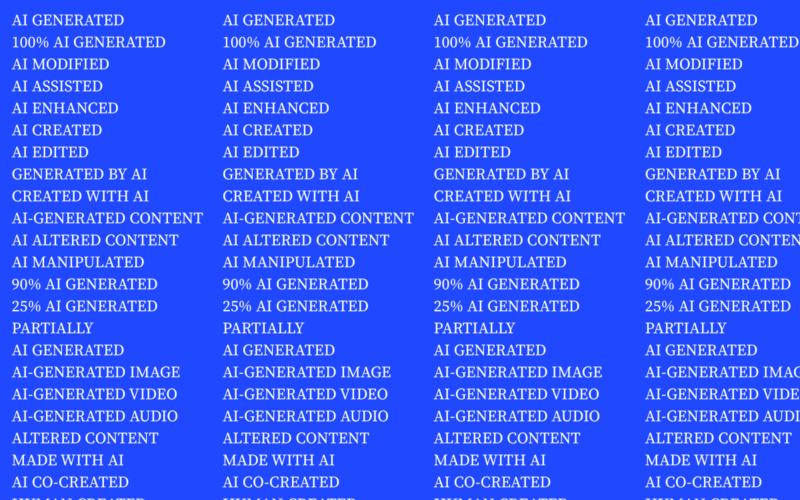
We also need a more nuanced way to talk about AI than simply slapping an “AI-generated” label on something. Because what does that label actually tell us? Did AI create the entire ad from scratch? Did a copywriter use it to polish a headline? Did a designer use it to adjust an image? Or did an advertising platform use AI to test dozens of combinations of human-created content to find the one most likely to resonate with an audience? These are very different uses of AI, but we risk lumping them all together under the same label. If we’re serious about transparency, we need to explain:
- Whether AI was involved
- How it was used exactly
- What role people played in the process
Ultimately, though, people are going to judge based on perceptions, and perceptions are emotional. Don’t let the AI conversation distract you from making an emotional connection with your audience.