


Imagine you are thinking of how to start a cosmetics or skincare brand in today’s reality of 2026. Let’s say you have a good, tested formula and your design is solid. How would you estimate your chances of survival and profitability during the first year?
To add a little more context, here are some statistics on the beauty market. The skincare industry includes around 16,500 businesses globally, and it has grown by 5% yearly for the last 5 years. New entrants compete against a huge existing base, but the crown is shared among just a few players (L’Oréal, Unilever, Beiersdorf) that control a large share of total revenue.
Indie producers have their niche and their customer in this market – so it seems there will certainly be some place for your skincare brand, right? Well, not really. Just having a popular formula, wrapping it in a nice design, listing it on Amazon, or on a pretty Shopify website, and hoping for the best is simply not enough for successful skincare branding. Thousands of indie brands and skincare startups do exactly the same with white-label labs and the same handful of “hero” actives (niacinamide, AHA/BHA, retinol, silicone bristles, etc.). But there’s one important ingredient that many small and medium brands skip adding to their business formula: brand positioning.
A properly elaborated brand positioning, grounded in data and validated for market fit, can help you enter the market and cement your position and economic success more cost-efficiently than anything else (and not only at pre-launch but at any stage of business growth). Skincare brands can win without being the best-formulated or most uniquely designed, but because they own the sharpest idea of their functional and emotional value which becomes their strongest beauty marketing tool.
Proven Systems for Business Owners, Marketers, and Agencies
→ Our mini-course helps you audit and refine an existing brand in 15 days, just 15 minutes a day.
→ The Ultimate Brand Building System is your step-by-step blueprint to building and scaling powerful brands from scratch.
Table of Contents
A Quick Look at the Fundamentals
Before exploring how skincare brands use positioning to stand out, let’s clarify two closely related concepts: brand positioning and brand identity. Understanding the difference will help us better appreciate the strategies behind each example within the skincare industry.
Brand positioning defines how a brand is different from its competitors and where, or how, it wants to sit in customers’ minds. Effective brand positioning helps consumers see a brand as favorable, different, and credible, driving willingness to purchase.
Tailoring this definition to your skincare brand, brand positioning isn’t a slogan, and it’s not a vibe. It’s a specific, defensible claim about what your skincare actually does for someone, and why that claim belongs to you and not to whoever launches next month with a similar formula.
Now, how is it different from brand identity? Brand identity refers to unique characteristics that influence a brand’s perceived personality, appearance, and behavior. Those are communicated through the brand’s name and personality; visual identity elements like logo, color, design style, etc.; the brand’s communication style and tone of voice; perceived product quality and functionality; public behavior; and social and environmental impact.
The most common mistake the business founders make is investing time and effort into visual identity (very often relying on gut feeling and personal taste only) – a beautiful logo, a Pinterest-perfect palette, and slacking on building brand positioning.
Why do thousands of founders, even successful ones, fall into this trap so easily? In visually savvy niches like skincare, businesses are especially prone to that because of a plethora of competition and thus – the references. This also happens because designing a logo and building a website are much clearer and simpler tasks than researching the market, comparing your competitors’ positioning, and validating your positioning-market fit.
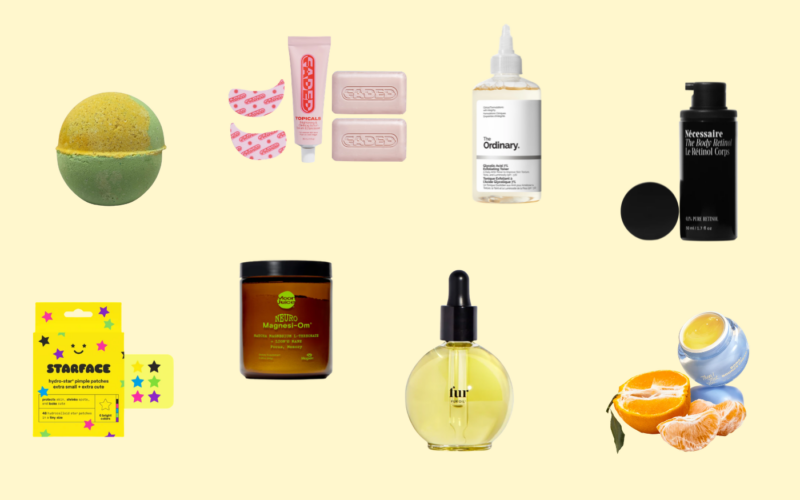
To illustrate what happens when founders don’t oversee this step, I gathered 8 brands with hands-down positioning that brought them to the top of their niche. Some of them even created their own unique “blue ocean” market.
1. Moon Juice
One-liner: Nutritional supplements and skincare rooted in ancient plant medicine, blending spiritual rituals with modern everyday wellness.
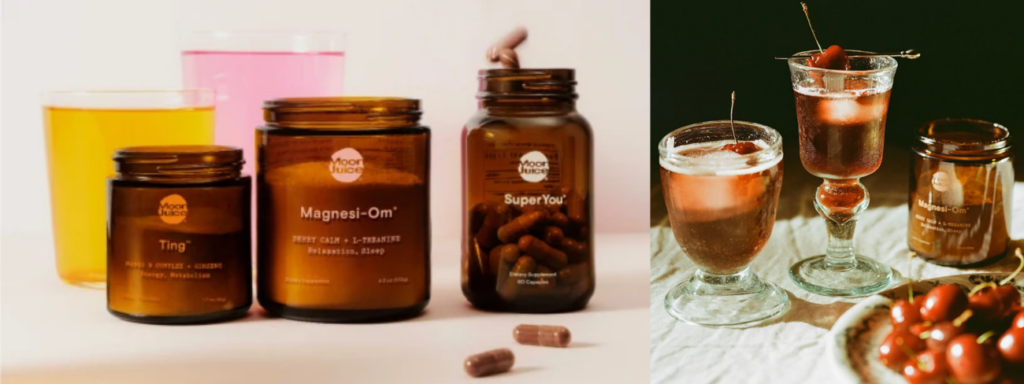
I’ll start with a non-typical skincare company. Yet, their positioning, visual language, and strategy are some of the most unique not only in their niche, but in the entire e-commerce. Moon Juice is a supplement brand founded by Amanda Chantal Bacon in 2011, inspired by her own story of recovery through Ayurvedic medicine. But it wouldn’t be on this list if it were just another Ayurveda-driven brand.
Moon Juice treats skincare and supplements as one continuous “beauty from within” ritual.
The products are positioned as “a healing force, an etheric potion, a cosmic beacon for those seeking out beauty, wellness and longevity”. Moon Juice’s brand positioning blends ancient wisdom and mysticism, yet it is positioned as a modern, cutting-edge, contemporary brand.
No mysterious dusts, Hindu or Chinese traditional symbols – only a stylish, minimalist, and modern identity, ancient knowledge reconsidered by today’s science (like adaptogens), and products for tabooed issues like sexual health and wellbeing. No hedging with clinical disclaimers, no “may help support.” This unique combo turned it into a successful business that raised $7 million in Series C.

2. Lush
One-liner: Freshness of cosmetics made like food.
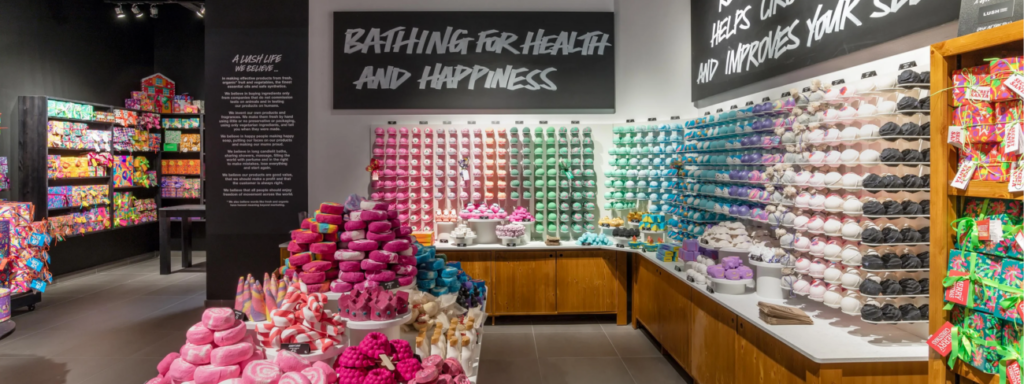
British cosmetics brand that helps you spot their store with vanilla, rose, and mint cookie smells even before you see the shop – like a bakery or a flower shop. Lush Cosmetics’ branding has come a long way, but since its foundation in 1995, Lush has positioned itself directly against the rest of the cosmetics industry with a simple idea: if you want your food to be fresh, why not set the same standards for your cosmetics?
That single idea was justified with handmade products by real people behind it, small-batch production, expiry dates, anti-animal testing, and mostly packaging-free solid bars. Lush brilliantly differentiated itself from their competitors for selling “sterile, stale chemical concoctions.” Additionally, Lush heavily positions itself as an inclusive brand – because freshness is a quality standard regardless of sex, age, or social status.
3. Then I Met You
One-liner: Skincare doesn’t need to be a hard-built routine; it is a self-care relationship you build by choice.
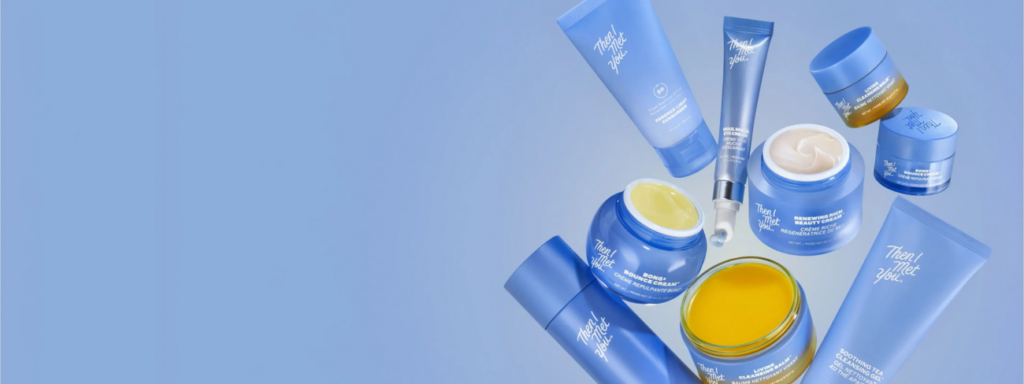
In the foundation of this skincare brand lies the Korean idea of jeong – the accumulated affection that grows over time. Then I Met You did something very smart. They realized that what people actually struggle with is buying another cream, toner, or beauty tool and then feeling guilty of abandoning it after a couple of times, because they struggle to build a routine. The brand positioning says: you don’t need to force yourself. Look at our products – it’s a sensorial pleasure (textures described as “sorbet-soft”), a sensorial ritual worth looking forward to. As a brand, Then I Met You stepped away from competing on active ingredients and won the market by replacing the feeling of something you need to endure with something you are indulging yourself with.
4. Fur
One-liner: Taking beauty’s most avoided category and refusing every shortcut that would make it easier to sell.
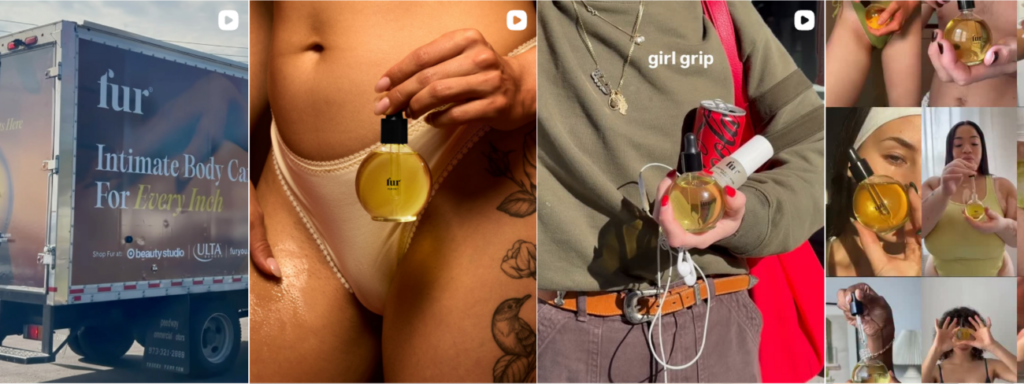
This brand took a different approach – not ingredients, not packaging, or shape – but the application area! Fur created cosmetics for pubic care – and built a category the rest of the industry pretended didn’t exist.
Unlike other brands that offer hair removal solutions, Fur built skincare products for pubic and other areas of body hair removal. They deliberately kept the word “pubic” on the label, and invested in dermatological and gynecological testing before launch.
Fur founders destigmatized a taboo and built a blue ocean with a product so credible and with branding of high prestige that the taboo stopped mattering.
5. Topicals
One-liner: Reframing “unfixable” skin conditions around mental health and inclusion instead of a cure.
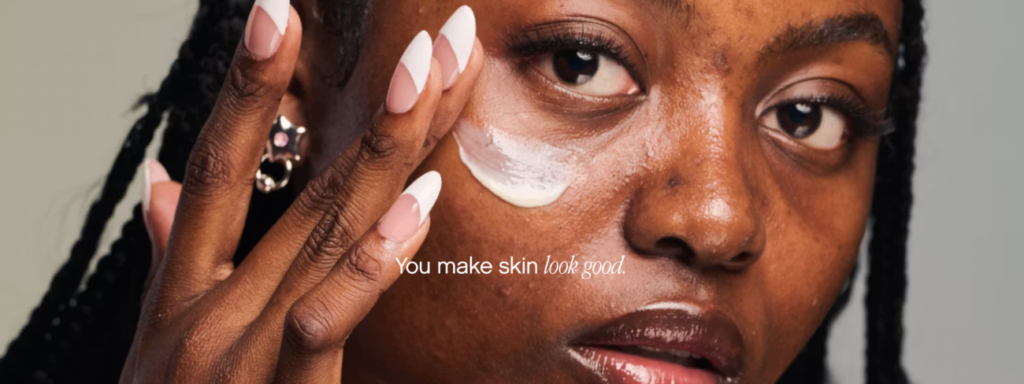
From the beginning, Topicals focused on a specific audience, creating solutions for people with chronic skin conditions like eczema, psoriasis, and hyperpigmentation. Obviously, they were not alone in this market, and to win the competition, they did something absolutely brilliant – and no, it wasn’t overinvesting and building revolutionary formulas.
Topicals figured out that people with chronic skin conditions have dramatically higher rates of depression and anxiety because of social stigma and beauty culture’s obsession with “clear skin” as a moral outcome. Unlike many other skincare brands in this niche, they explicitly rejected “clear skin” as the goal and replaced it with inclusion and mental-health-forward permission to just have the skin you have.
They figured out that rather than a cream, people needed a safe place to talk about problems without shame. So on top of their brand, Topical built a platform – a place where “people are excited to talk about skin conditions that they once deemed shameful”. The result was a total success. In January, 2026 Topicals announced a new round of financing, and the brand reports that it has raised more than $22.6 million since the company’s foundation.
6. Starface
One liner: Turning the thing you hide into the thing you show off.
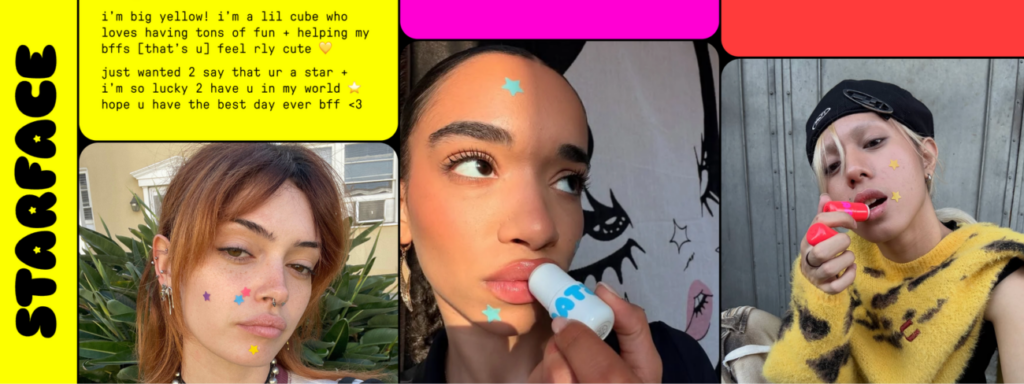
Starface also used Topical’s approach and flipped the entire paradigm of acne treatment with a brilliant positioning. Before, the pimple patches were designed to be invisible, but Starface makes a neon-yellow, star-shaped patch designed to be seen, basically turning the bug into a feature. Now Starface patches are worn on runways, in ad campaigns, and as a fashion accessory. Why was it a successful positioning move? Because it wasn’t based on pure instinct, but grounded in research and an understanding of market needs.
Starface’s primary target audience is Gen Z, known for being non-conformists. Gen Z didn’t want to hide acne; they wanted permission not to be embarrassed by it. Like Topicals clients, who wanted permission not to be embarrassed by eczema.
So Starface marketers figured out that the fastest way to grant that permission is to make the patch cool rather than camouflaged. In this case, the product became its own marketing: every visible patch is a walking ad and a small act of destigmatization at the same time.
It’s also worth noting: the patches aren’t positioned or reviewed as the most clinically potent option for treating acne on the market. Instead, Starface focused on explicitly selling identity and belonging.
7. Nécessaire
One liner: Skin doesn’t stop at the neck.
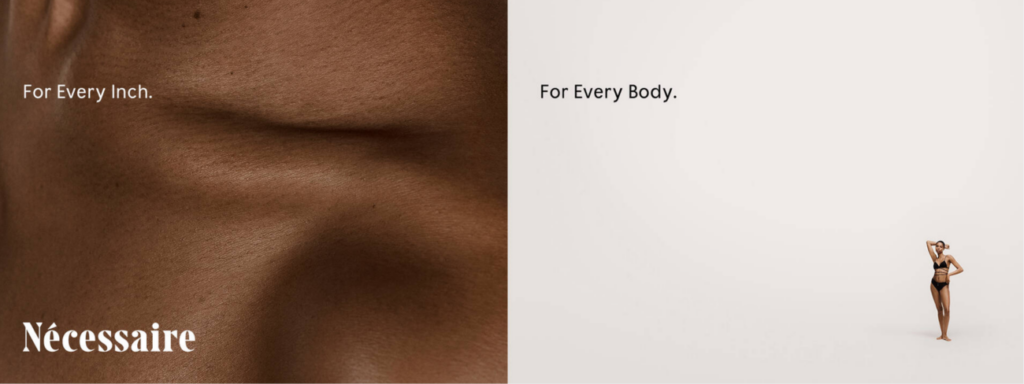
When we think about cosmetics and skincare solutions in general, we usually limit it to our face. As a result, thousands of brands are competing in the same market with similar positioning and promises of “glowing face”, “wrinkle-free tightened oval”, etc. We usually treat our body as an afterthought category (lotion, deodorant) while the face gets all the “skincare” science, language, and price point.
And this is where Nécessaire saw an opportunity. They reframed this hierarchy and applied the same ingredient rigor (hyaluronic acid, ceramides, exfoliating acids) and the same seriousness below the chin. To translate this positioning, the brand built an internal filter to eliminate everything decorative or redundant – in messaging, design, and formulas. This filter turned out to be both a product-development discipline and a positioning statement about restraint in a category prone to endless line extensions and often redundant features and components.

8. The Ordinary
One-liner: Pure active ingredients speaking for themselves, with a personality built out of having none.
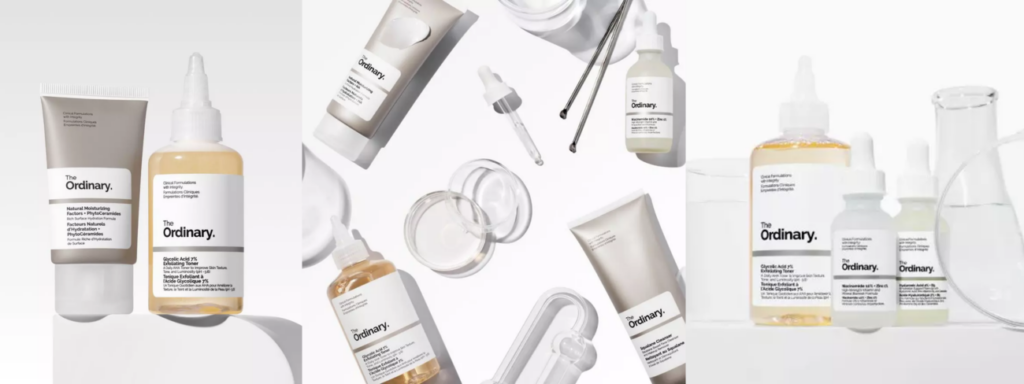
The Ordinary is a particularly interesting case as it built its product marketing by removing any marketing fluff at all. You can say The Ordinary is like baking soda in the world of cosmetics – you buy baking soda because, well, you need the soda. You buy it for the ingredient itself – carbon dioxide.
The Ordinary doesn’t sell ritual, indulgence, or mood, and this idea came from the brand’s own pitfall. Launched in August 2016 by DECIEM, it was the company’s eleventh brand, and the earlier ones, as DECIEM’s CEO has admitted, mostly didn’t work. At the time, most beauty brands ran on the same model: glossy campaigns, poetic claims, aspirational imagery, and a price tag that paid for all of it. This inspired The Ordinary to do exactly the opposite and position itself against the entire model no marketing fluff, the ingredients sell themselves; those who know will know, and those who don’t will educate themselves.
Products were named like laboratory reagents, purely ingredient-led, so the name told you the ingredient and the dose. Like their “Niacinamide 10% + Zinc 1%,” or “Vitamin C 23% suspension + HA spheres 2%”. The packaging was also built very uniformly, looking like laboratory ampoules.
Why did this positioning work so well? Because The Ordinary built trust on their transparency and made the product choice easy, eliminating the frustrating guesswork and saving money on choosing the exact right product for customers who were tired of paying for storytelling.
This is the move that made The Ordinary so successful and earned them a place on this list: “no personality” can be a personality if it is consistent and has a solid foundation. Nothing was hidden behind The Ordinary brand mood, so there was nothing to decode.
Every label, name, and price point says the same thing, so the positioning is visible in the product itself. The result was a financial success. When Estée Lauder agreed in 2021 to pay $1 billion for a controlling stake in DECIEM, it specifically credited The Ordinary’s community- and referral-driven buzz.
Why These, and Not Others
Brands like Glossier, Drunk Elephant, or Youth To The People were left off deliberately. They’re well-designed and commercially successful, but their differentiation is mostly aesthetic or ingredient-philosophy (millennial pink, “no suspicious 6,” superfoods) rather than a genuinely distinct idea about what skincare is for.
All eight brands above were chosen because they found a unique answer, grounded in market research, to the question: “What is skincare actually for my target audience, and what has everyone else gotten wrong about that?”
And that’s the key takeaway: armed with clear and specific positioning, these skincare brands managed to stand out from their competitors and even the rest of the market, build a memorable story, reduce costly investments in formulation and design, and ultimately create financially successful businesses.